
ΔΙΑΤΑΞΗ ΟΡΙΣΜΕΝΩΝ ΟΛΟΚΛΗΡΩΜΑΤΩΝ
ΕΦΑΡΜΟΓΗ

Λύση
1.) Αρκεί να αποδείξουμε ότι  είναι:
![\[\sqrt{x + 1} \leq \dfrac{x + 2}{2} \Leftrightarrow\]](https://study4maths.gr/wp-content/ql-cache/quicklatex.com-4ca15e711e8ac50d7471628ad9c88aad_l3.png "Rendered by QuickLaTeX.com")
![\[2\sqrt{x + 1} \leq x + 2 \Leftrightarrow\]](https://study4maths.gr/wp-content/ql-cache/quicklatex.com-2f5549ed07239b2726655b5468dea776_l3.png "Rendered by QuickLaTeX.com")
![\[2\sqrt{x + 1} - x - 2 \leq 0\]](https://study4maths.gr/wp-content/ql-cache/quicklatex.com-e4c4b437ac3d492ff116e9aa427d3a1c_l3.png "Rendered by QuickLaTeX.com")
Θεωρούμε τη συνάρτηση:
![\[f(x) = 2\sqrt{x + 1} - x - 2, ~\text{με} ~ x \in [-1, +\infty)\]](https://study4maths.gr/wp-content/ql-cache/quicklatex.com-e3037fa457161cf1f07e48b9ca2c09bc_l3.png "Rendered by QuickLaTeX.com")
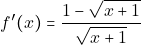
Για κάθε  είναι:
![\[f'(x) = \dfrac{2}{2\sqrt{x + 1}} - 1 \Leftrightarrow f'(x) = \dfrac{1 - \sqrt{x + 1}}{\sqrt{x + 1}}\]](https://study4maths.gr/wp-content/ql-cache/quicklatex.com-7f8e989ea260f78fea21246f04b6df26_l3.png "Rendered by QuickLaTeX.com")
Επίσης για  έχουμε:
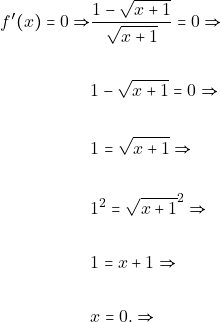
Επιπλέον,
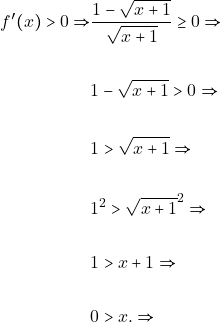
Τέλος οι ρίζες και το πρόσημο της  καθώς και η μονοτονία της
  φαίνονται στον πίνακα τιμών
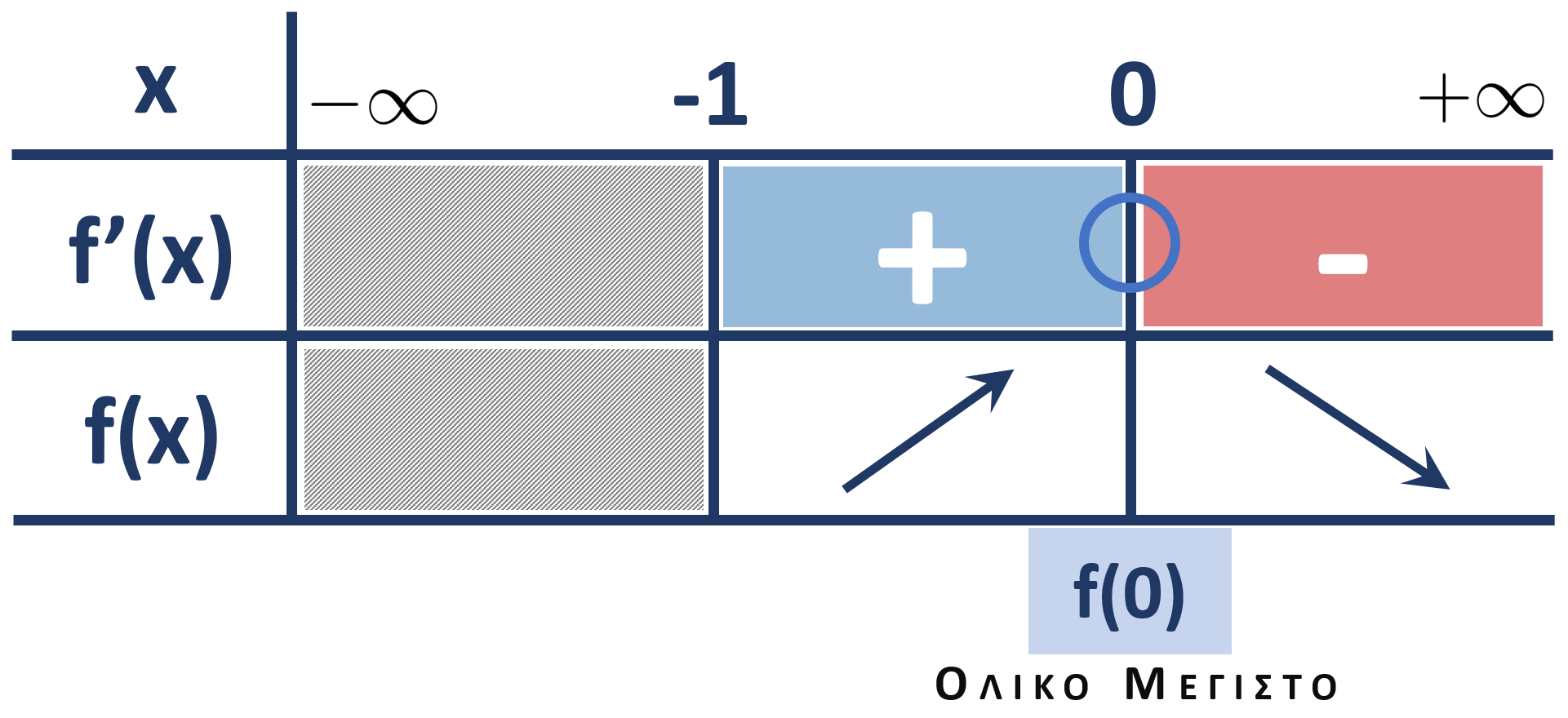
 και μονοτονίας της
Η  παρουσιάζει ολικό μέγιστο για
  το:
το:
![\[f(0) = 2\sqrt{0 + 1} - 0 -2 = 0\]](https://study4maths.gr/wp-content/ql-cache/quicklatex.com-5ebde996fcce6241f6b9b3021bde3ae6_l3.png "Rendered by QuickLaTeX.com")
Άρα  ισχύει ότι:
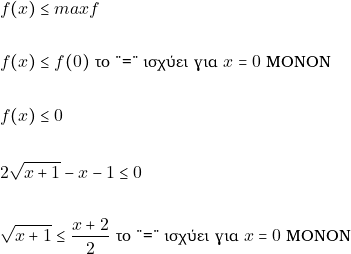
2.)Για κάθε  ισχύει ότι
όποτε θα ισχύει και για  δηλαδη:
![\[\sqrt{x^3 + 1} \leq \dfrac{x^3 + 2}{2}, ~\text{για κάθε } x \in [0, 1]\subset [-1,+\infty)\]](https://study4maths.gr/wp-content/ql-cache/quicklatex.com-fe6303a2e333601cb10d7c110378818e_l3.png "Rendered by QuickLaTeX.com")
επειδή το  ισχύει για
  ΜΟΝΟΝ
ΜΟΝΟΝ
Έτσι από ΘΕΩΡΙΑ ΓΙΑ ΤΗΝ ΔΙΑΤΑΞΗ ΤΩΝ ΟΛΟΚΛΗΡΩΜΑΤΩΝ
έχουμε ότι:
![\[\displaystyle\int_0^1 \sqrt{x^3 + 1} ~dx < \displaystyle\int_0^1 \dfrac{x^3 + 2}{2} ~dx\]](https://study4maths.gr/wp-content/ql-cache/quicklatex.com-a865c99c39a5bf3768596afc39b3106a_l3.png "Rendered by QuickLaTeX.com")
Όμως είναι:
![\begin{align*} \displaystyle\int_0^1\dfrac{x^3 + 2}{2} ~dx & = \displaystyle\int_0^1 \bigg(\dfrac{x^3}{2} + 1\bigg) ~dx = \\\\ & = \bigg[\dfrac{x^4}{8} + x\bigg]_0^1 = \dfrac{1}{8} + 1 - 0 = \dfrac{9}{8} \end{align*}](https://study4maths.gr/wp-content/ql-cache/quicklatex.com-72cb92d62c84dd74daadbf350310d1fd_l3.png "Rendered by QuickLaTeX.com")
Τελικά:
![\[\int_0^1 \sqrt{x^3 + 1} ~dx <\dfrac{9}{8}\]](https://study4maths.gr/wp-content/ql-cache/quicklatex.com-b799d7a66338ec93e3a9b149a08bad2b_l3.png "Rendered by QuickLaTeX.com")
Βιβλιογραφία: Παπαδάκης εκδόσεις Σαββάλα.

Αυτή η εργασία χορηγείται με άδεια Creative Commons Αναφορά Δημιουργού – Μη Εμπορική Χρήση – Παρόμοια Διανομή 4.0 Διεθνές .